Mental fitness assessments for political leaders as a form of checks and balances
They’re performed for some military and civilian roles - why not for political leaders with power to do mass violence?
This is going to be an exercise in using publicly available tools to develop mental fitness assessments of political leaders. The motivation is that these assessments can potentially say something useful about the likelihood of harmful governance.
The idea is not new. Constitutions such as Nigeria's already include mentions of it. Outside of politics, mental fitness or psychological assessments are used in areas like national security, nuclear safety, and aviation. Some minimal risk assessment may be required for individual firearm ownership in many countries. Which raises the question of why nothing comparable is systematically done for people who can deploy militaries and violence at mass scale.
Current challenges
The challenges with these assessments include:
- Professionals who may be the most qualified to evaluate this, such as psychiatrists or other mental health professionals, are prohibited or discouraged from doing so.
- Evaluating vast amounts of public data on leaders, including speeches, social media, news articles, historical accounts, and other sources - requires analytical tools and computational power that were not available until recent years.
There is a history of pseudoscience around this. Psychiatry also has been historically weaponized. Both are important to call out. This exercise is not going to solve all these challenges. Instead, it can be used as a rough blueprint for developing something more rigorous. Suggestions how are offered in the final section.
The analysis below uses ChatGPT as an exploratory, low-barrier starting point. Briefly, the steps are:
- Compile a list of characteristics of interest
- Compile a list of historical figures and political leaders
- Use an LLM for assessment
Step 1: leader characteristics
The following list is based on a literature review about leader personality. It is not a rigorous and validated list. It casts a fairly wide net that can be pared down later.
- Narcissism (grandiosity, excessive need for admiration, inability to tolerate criticism)
- Paranoia
- Machiavellianism
- Sadism
- History of violence or aggression
- Drive for dominance
- Authoritarianism
- Aversion/hatred (intolerance, out-group hostility, us vs. them struggle, polarized thinking)
- Grievances
- Greed/craving (for material, e.g. wealth, natural resources, territorial expansion or intangible, e.g. status)
- Nostalgia
- Cognitive rigidity
- Low empathy
- Impulsivity
Each characteristic is rated from 1 to 5. A higher total score indicates higher risk.
Step 2: historical and modern leaders
The list of 40 leaders below was chosen to include all US presidents since World War II and select historical and modern leaders. While it has representation from different geographic regions, the list is skewed toward the west and toward a more recent time period.
- Bashar al-Assad
- Jacinda Ardern
- Joe Biden
- George H. W. Bush
- George W. Bush
- Jimmy Carter
- Bill Clinton
- The Dalai Lama (14th)
- Dwight D. Eisenhower
- Recep Tayyip Erdoğan
- Gerald Ford
- Adolf Hitler
- Lyndon B. Johnson
- John F. Kennedy
- Paul Kagame
- Sanna Marin
- Javier Milei
- Narendra Modi
- Giorgia Meloni
- Angela Merkel
- Nelson Mandela
- Benjamin Netanyahu
- Richard Nixon
- Viktor Orban
- Barack Obama
- Vladimir Putin
- Cyril Ramaphosa
- Ronald Reagan
- Idi Amin
- Ellen Johnson Sirleaf
- Joseph Stalin
- Aung San Suu Kyi
- Margaret Thatcher
- Donald Trump
- Harry S. Truman
- Saddam Hussein
- Emmanuel Macron
- Justin Trudeau
- Xi Jinping
- Volodymyr Zelenskyy
Step 3: LLMs for analysis
An example prompt for can look like the following:
The results below were generated using ChatGPT in February 2025.
Results

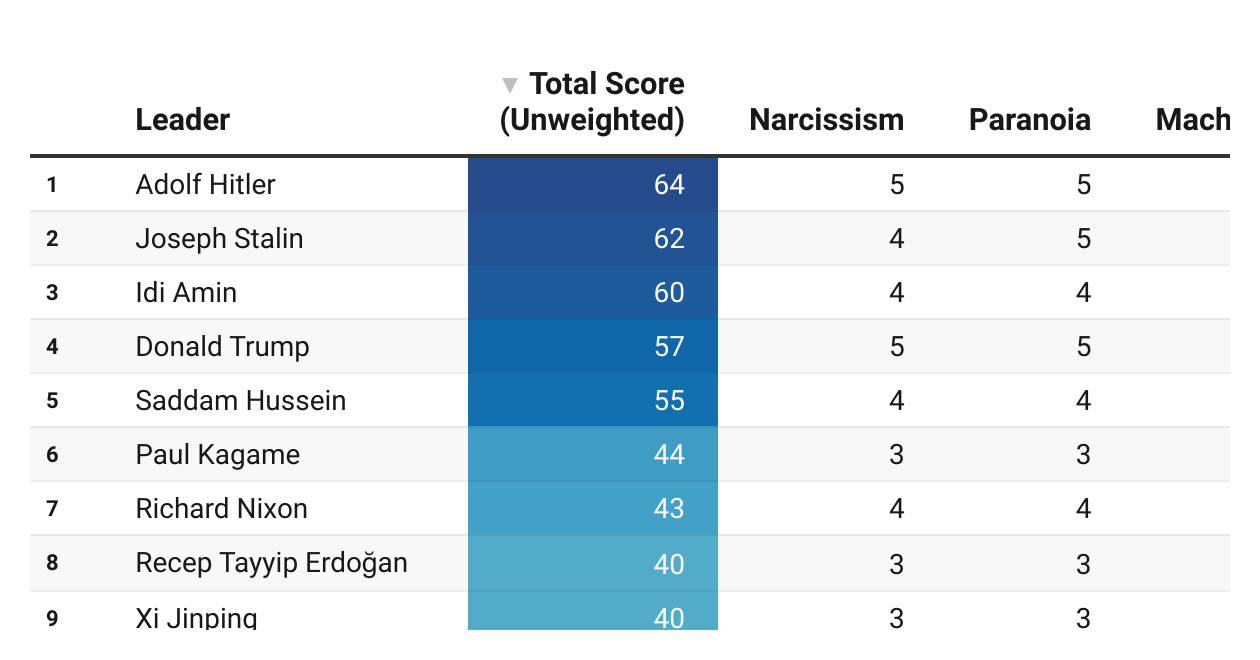
Note: the full table can be viewed here: https://www.datawrapper.de/_/6SNwZ/
An eyeball test of the results reveals at least a moderate relationship between pre-power characteristics of leaders and later conflict initiation.
- Hitler, Stalin, and Idi Amin all rank at the top and demonstrated pre-power tendencies toward paranoia, dominance, and hostility toward out-groups.
- Several leaders on the list assumed power under a system with institutional checks and balances then proceeded to successfully erode them. Hitler’s dismantling of the Weimar Republic is one example. More recently, a pattern of erosion of institutional safeguards and a rise in authoritarianism has been experienced in Turkey under Erdoğan, Hungary under Orban, and the US under Trump. Erosion of checks and balances is important to pay attention to because unchecked leaders are more likely to initiate conflict.
- Leaders with the lowest scores include US presidents Joe Biden, Jimmy Carter, and Barack Obama, and global leaders including South Africa’s Nelson Mandela, Volodymyr Zelenskyy of Ukraine, Finland’s Sanna Marin, and the 14th Dalai Lama.
- False negatives such as Bashar al-Assad, who did not score very highly but went on to commit devastating violence in Syria - suggest limitations in the model’s usefulness to predict behavior once in power.
Ethical concerns
- Psychological assessments can be misused or weaponized to screen out individuals or groups.
- The 2017 debate about the Goldwater Rule, though limited to psychiatry, exposed divisions about the longstanding practice of discouraging professionals from attempting to diagnose or make statements about the mental fitness of presidential candidates.
- Many common mental health conditions such as depression are not linked to higher risk of violence. Care must be taken to minimize stigma.
Other important limitations
- Definitions: leader characteristics - needs development and validation. A history of pseudoscience in this area is one reason scholars are hesitant to approach the subject. Although that's starting to change.
- Definitions: the outcomes of interest can include everything from initiation of war (easier to operationalize) to a broad definition of violence used by the World Health Organization.
- Hindsight bias: While LLMs may be instructed to use only pre-office information, we know that's likely not the case given their training.
- Replication: LLM generated results are opaque, in that it’s unclear how AI tools define and rate psychological traits, even when some instruction is provided and the same LLM version is used.
Conclusions & future directions
Some limitations can be addressed through 1) development and validation of trait definitions, 2) improved methods and measures (computational social science approaches such as text as data, training historical LLMs up to certain time periods), and 3) development of predictive models.
An analogy from public health is syndromic surveillance. It uses data from sources such as emergency departments to flag syndromes based on a collection of symptoms (e.g. respiratory). The pattern detection is viewed an early warning rather than a definitive diagnosis. With that said, psychiatrist and violence scholar Bandy Lee and her colleagues have argued since 2017 for formal mental fitness assessments of leaders with access to lethal means. The US war with Iran in 2026 shows that this is not a hypothetical.
The risks of such assessments are real - Soviet psychiatry was notorious for suppressing political dissidents. At the same time, the risks of professional silence like the Goldwater rule in the US create underappreciated information asymmetries.
Reasonably-developed risk assessment won't solve the problem of unchecked leaders initiating conflict. However, the current status quo in social science is that leader psychology is less relevant. The focus is tilted toward institutions. An improved research agenda can also explore the extent to which leaders with certain characteristics are more likely to engage in eroding the systems of domestic and international safeguards. Beyond conflict, it is also worth asking which leaders are more likely to practice peaceful and inclusive governance.
Note: an earlier version of this post was published here in February 2025.